What Is the Line Array Effect?
Sound Talks
What Is the Line Array Effect?

In large or acoustically challenging spaces, delivering clear and evenly distributed sound can be difficult―especially in large halls, stations, and outdoor areas.
Even when loudspeakers appear similar, the way they spread sound can differ significantly.
This page introduces the basic concept behind the Line Array Effect, a sound control principle used in modern line array speaker systems. It helps deliver clearer and more consistent audio coverage across wide areas.
Point Source vs. Line Source
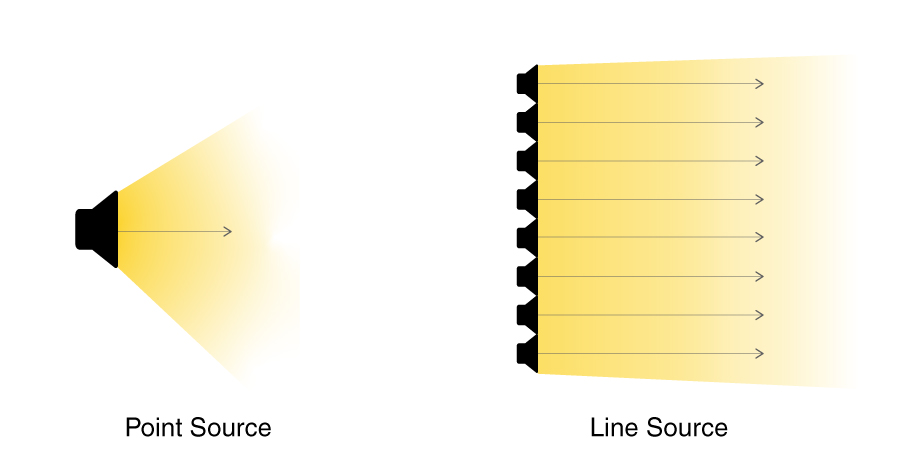
To understand the Line Array Effect, it helps to first look at how different types of sound sources behave. Most conventional loudspeakers function as a point source, meaning sound is emitted from a single point and spreads outward in all directions.
In contrast, systems that produce the Line Array Effect act as a line source.
A line source is formed by arranging multiple small sound sources vertically and driving them at the same time. While each individual unit behaves as a point source, their combined output functions as one continuous, line‑shaped sound source, commonly used in professional sound systems, as shown in the diagram.
Why Line Arrays Deliver Clearer Sound
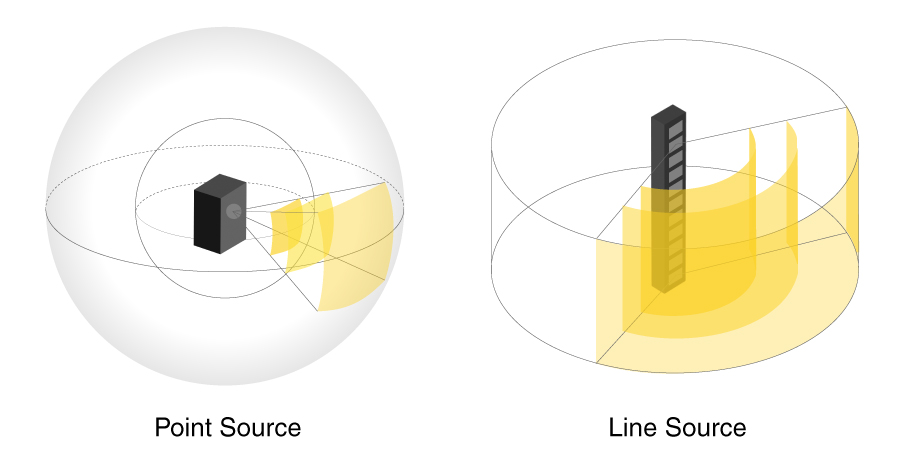
Because sound is emitted along a vertical line, a line source produces a more controlled wavefront. This helps reduce unnecessary sound spread toward ceilings and floors, limiting unwanted reflections—a common problem in large buildings.
As the sound travels forward, the individual waves combine smoothly. This makes it easier to maintain clarity and consistent sound levels for listeners both near and far, particularly in large spaces where conventional speakers often cause uneven volume.
Where Line Arrays Work Best
Line array systems are well suited to environments where clear sound must reach many people over long distances.
Typical applications include stadiums, arenas, train platforms, airports, outdoor event venues, and disaster‑warning or public announcement systems.
In these spaces, controlling sound dispersion plays an important role in maintaining intelligibility and overall coverage—especially for speech announcements.
Supporting Better Speech and Music
By precisely controlling vertical sound dispersion, line arrays deliver sound only where it is needed. This reduces unnecessary reflections and helps improve speech intelligibility even in reverberant environments.
For music playback, line arrays provide a stable and natural listening experience, allowing audiences at different distances to hear balanced sound levels.
For these reasons, line array speaker systems are widely used in large‑scale sound reinforcement today.